
The Business Behind a Direct EB-5 Investment
Direct EB-5 is a path to U.S. Permanent Residency through an investment in a U.S. business that creates jobs.
It is often associated with entrepreneurs starting their own companies. But Direct EB-5 can also involve investing in an existing business structure.
Related: what makes a business eligible for Direct EB-5
Either way, the immigration requirements are only part of the picture. The business receiving the investment has to operate, hire employees, use the invested capital as planned, and carry out the business plan.
TADE Consulting currently offers a Direct EB-5 opportunity centered on urgent care clinics in the United States.
Learn More About the Direct EB-5 Urgent Care Opportunity →What Is Direct EB-5?
Direct EB-5 is a form of the EB-5 Immigrant Investor Program in which an investor makes a qualifying investment in a U.S. commercial enterprise without investing through a Regional Center.
The investment must satisfy EB-5 requirements, including the applicable minimum investment amount and the creation of at least 10 qualifying full-time jobs for U.S. workers.
For investors considering Direct EB-5, the business is therefore central to the immigration strategy. Its structure, operations, hiring plan and use of investment capital all matter.
USCIS distinguishes these investors from Regional Center investors through Form I-526, which identifies as the petition for a standalone investor.
What Does Direct EB-5 Require?
A Direct EB-5 investment must meet several core requirements.
Investment Amount
As of September 2026, the standard minimum EB-5 investment amount is $1,050,000 for non-TEA areas. A minimum investment amount of $800,000 applies to qualifying investments in Rural or TEA areas, eligible for the reduced statutory threshold.
- Standard minimum (non-TEA)
- $1,050,000
- Reduced threshold (Rural / TEA)
- $800,000
Whether a particular Direct EB-5 opportunity qualifies for the $800,000 amount depends on the facts of that specific investment. Investors should not assume that every Direct EB-5 opportunity qualifies for the lower amount.
Job Creation
Each EB-5 investor must be associated with the creation of at least 10 qualifying full-time jobs.
In a Direct EB-5 structure, job creation is tied directly to the operating business rather than being calculated through the broader economic methodologies available to Regional Center investments. USCIS materials distinguish direct jobs as identifiable jobs within the commercial enterprise from indirect jobs available in the Regional Center context.
Lawful Source and Path of Funds
The investor must document the lawful source and path of the investment funds in accordance with applicable EB-5 requirements.
How those requirements apply to an individual investor's circumstances should be determined with qualified immigration counsel.
Investment in a U.S. Commercial Enterprise
The capital must be invested in a qualifying U.S. commercial enterprise.
That enterprise may take different legal and operational forms depending on the structure of the business and investment.
Explore this topic: Direct EB-5 requirements →
Does a Direct EB-5 Investor Have to Run the Business?
A common misconception about Direct EB-5 is that the investor must personally operate the business every day.
Direct EB-5 does involve requirements concerning the investor's participation in the enterprise, but that should not automatically be interpreted to mean that the investor must personally perform the day-to-day work of running the company.
The investor's role depends on the structure of the enterprise and the rights and responsibilities associated with that structure.
This distinction becomes particularly important when evaluating businesses that require professional management, specialized operators or licensed professionals.
Ownership, Investor Role and Daily Operations
Ownership, investor participation and daily business operations are related, but they are not the same thing.
A business can have investors with defined ownership and participation rights while relying on experienced management to handle daily operations.
That distinction is very important in industries where operating the business requires specialized experience.
Healthcare is a good example.
A healthcare business may involve investors, business management, medical professionals, administrative staff and other employees with very different responsibilities.
How Does Direct EB-5 Job Creation Work?
Job creation is one of the central requirements of the EB-5 program.
Each investor must be associated with at least 10 qualifying full-time positions for U.S. workers.
In Direct EB-5, those jobs must generally exist within the qualifying business structure rather than being calculated through the indirect-job methodologies used in the Regional Center program.
Job creation should also be considered in connection with the underlying business:
- How many employees will the business require?
- When will those employees be hired?
- Which entity will employ them?
- Does the operating plan support the required staffing?
- Is the hiring plan consistent with how the business will actually operate?
That connection between the operating business and its employment needs is crucial in Direct EB-5 planning.
Explore this topic: Direct EB-5 job creation →
Direct EB-5 vs. Regional Center EB-5
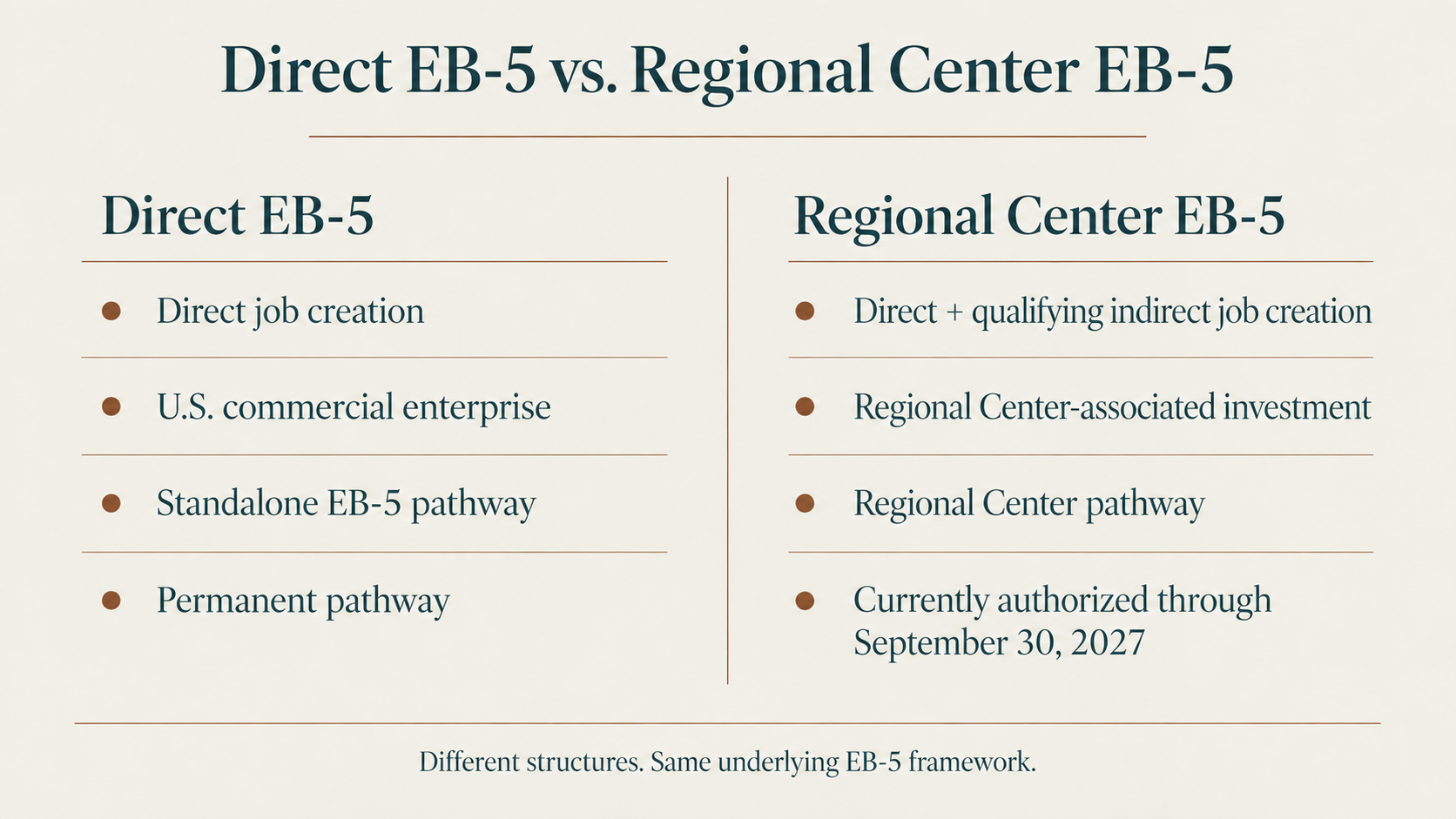
Direct EB-5 and Regional Center EB-5 operate under the broader EB-5 framework, but they are structured differently.
One of the most important differences involves job creation.
Direct EB-5 generally relies on qualifying jobs created within the business structure itself.
Regional Center investments may also receive credit for qualifying indirect employment calculated through accepted economic methodologies.
The investment structures and investor roles can also differ considerably.
Another distinction concerns the authorization of the programs.
Direct EB-5 is part of the permanent EB-5 program and does not depend on Congress periodically renewing the Regional Center Program.
The Regional Center Program is currently authorized through September 30, 2027.
Related: Does Direct EB-5 have a grandfathering deadline? →
This distinction is about the authorization of the program. It does not mean that Direct EB-5 is automatically safer, has less investment risk, or offers greater certainty of an immigration outcome.
Investors comparing the two paths should look beyond the labels and understand the structure of the specific investment they are considering.
Explore the full comparison: Direct EB-5 vs. Regional Center EB-5 →
TADE's Direct EB-5 Focus: Urgent Care
TADE Consulting currently offers a Direct EB-5 opportunity centered on urgent care clinics in the United States.
Urgent care has become an established part of how Americans access same-day medical care.
The United States now has more than 15,000 urgent care centers, and the industry serves more than 185 million patients annually, according to the Urgent Care Association.
Those numbers show the size of the sector. They do not tell us whether an individual clinic will succeed.

Why Urgent Care?
Urgent care clinics occupy a specific position within the U.S. healthcare system.
They provide access to care for medical needs that require timely attention but may not require treatment in a hospital emergency department.
Research has also examined urgent care as an alternative setting for certain lower-acuity conditions that can appropriately be treated outside an emergency department.
That does not mean urgent care replaces emergency care. The appropriate setting depends on the patient's medical needs.
Convenient Access to Care
Urgent care centers are designed around access to same-day care.
Patients commonly use them when their primary care provider is unavailable, when they need treatment outside traditional office hours or when a medical issue requires timely attention but is not an emergency.
This role has helped urgent care become an established part of the broader U.S. healthcare delivery system.
Location Matters
A large national market does not mean every location will have the same demand.
Individual clinic performance can depend on local demographics, competition, visibility, payer mix, operating hours, staffing, nearby healthcare providers and other market conditions.
Location analysis therefore remains an important part of evaluating an urgent care business.
Urgent Care Creates Operating Jobs
An operating urgent care clinic requires people.
Depending on the clinic structure, staffing may include medical professionals, clinical support staff, administrative employees, front-desk personnel and operational roles.
For Direct EB-5 purposes, however, the relevant question is not simply whether an industry employs people.
The specific business must have a staffing plan capable of supporting the qualifying job-creation requirements associated with its EB-5 structure.
Urgent care's established role in U.S. healthcare is one reason TADE selected the sector for its current opportunity. It does not mean that healthcare eliminates business or investment risk, or that any individual clinic is guaranteed to succeed.
We explore how healthcare works with Direct EB-5 in our article: Direct EB-5 through healthcare businesses →
Learn More About TADE's Direct EB-5 Urgent Care Opportunity
TADE Consulting currently offers a Direct EB-5 opportunity involving urgent care clinics in the United States.
Prospective qualified investors may request additional information regarding the opportunity.
Request InformationDisclosure
This information is for educational and informational purposes only and does not constitute an offer to sell or a solicitation of an offer to buy any security. Any offering will be made only through the applicable offering documents and in accordance with applicable securities laws.
Investments in private placements involve significant risk, including the potential loss of some or all invested capital, limited liquidity, and business and operational risks. There is no guarantee of investment performance, return of capital, or immigration outcome.
Securities offered through Innovation Partners LLC, Member FINRA/SIPC.
How Does the Direct EB-5 Process Work?
The exact process can vary depending on the investor and the business, but a Direct EB-5 investment generally involves several stages.
-
01
Understand the Business and Investment Structure
Understand the business, investment amount, entity structure, investor role, job-creation model and material considerations associated with the structure.
-
02
Review the EB-5 Requirements
The investment structure should be reviewed in connection with applicable EB-5 requirements, including investment amount, job creation, investor participation and the structure of the commercial enterprise.
-
03
Document the Source and Path of Funds
The investor must document the lawful source and path of the investment capital. The documentation required will depend on how the investor obtained and transferred the funds.
-
04
Make the Qualifying Investment
The investor makes the required investment in accordance with the applicable investment structure and EB-5 requirements.
-
05
File the EB-5 Petition
Standalone EB-5 investors file Form I-526, Immigrant Petition by Standalone Investor. USCIS separately identifies Form I-526E for Regional Center investors.
-
06
Obtain Conditional Permanent Residence
Following the required immigration process and applicable approvals, an EB-5 investor may become a conditional permanent resident.
-
07
Remove Conditions
The investor must later complete the process of removing conditions on permanent residence and demonstrate satisfaction of the applicable EB-5 requirements.
Qualified immigration counsel should advise investors regarding their individual immigration process and filing requirements.
Key Points to Remember
Direct EB-5 connects an immigration strategy to a real U.S. business.
That makes it important to understand both sides of the decision.
Investors should understand the immigration requirements, but they should also understand the business receiving their capital, how it will operate, how it plans to create jobs and what role the investor will have within the structure.
TADE Consulting helps clients think through complex cross-border business decisions with greater clarity, structure, and long-term perspective.
Direct EB-5 Frequently Asked Questions
What is Direct EB-5?
Direct EB-5 is an EB-5 structure in which an investor makes a qualifying investment in a U.S. commercial enterprise without investing through a Regional Center.
How much do I need to invest in Direct EB-5?
As of September 2026, the standard minimum EB-5 investment is $1,050,000. A reduced minimum of $800,000 applies to qualifying investments eligible for the lower statutory threshold, including qualifying investments in targeted employment areas.
Whether a specific opportunity qualifies for the reduced amount depends on the facts of that investment.
How many jobs must a Direct EB-5 investment create?
Each EB-5 investor must be associated with at least 10 qualifying full-time jobs for U.S. workers.
Do I have to start my own company for Direct EB-5?
Not necessarily.
Direct EB-5 is often associated with entrepreneurs creating their own businesses, but a Direct EB-5 structure may also involve investment in an existing business structure if the investment satisfies applicable EB-5 requirements.
Do I have to personally manage the business every day?
Not necessarily.
Investor participation and day-to-day business management are different concepts. The appropriate structure depends on the enterprise and applicable EB-5 requirements.
Can an urgent care clinic qualify for Direct EB-5?
A healthcare business such as an urgent care clinic may be considered for Direct EB-5 when the investment and business structure satisfy applicable EB-5 requirements.
The specific structure should be evaluated with the appropriate immigration, legal and other professional advisers.
Is Direct EB-5 safer than Regional Center EB-5?
Direct EB-5 and Regional Center EB-5 have different structures, but the Direct structure does not automatically make an investment safer.
Investors should evaluate the specific business, investment structure and associated risks rather than assuming that one EB-5 structure eliminates investment risk.
Is Direct EB-5 permanent?
The standalone Direct EB-5 pathway is part of the permanent EB-5 program. The Regional Center Program operates under separate congressional authorization.
This distinction concerns program authorization and should not be interpreted as a statement about investment safety or immigration certainty.